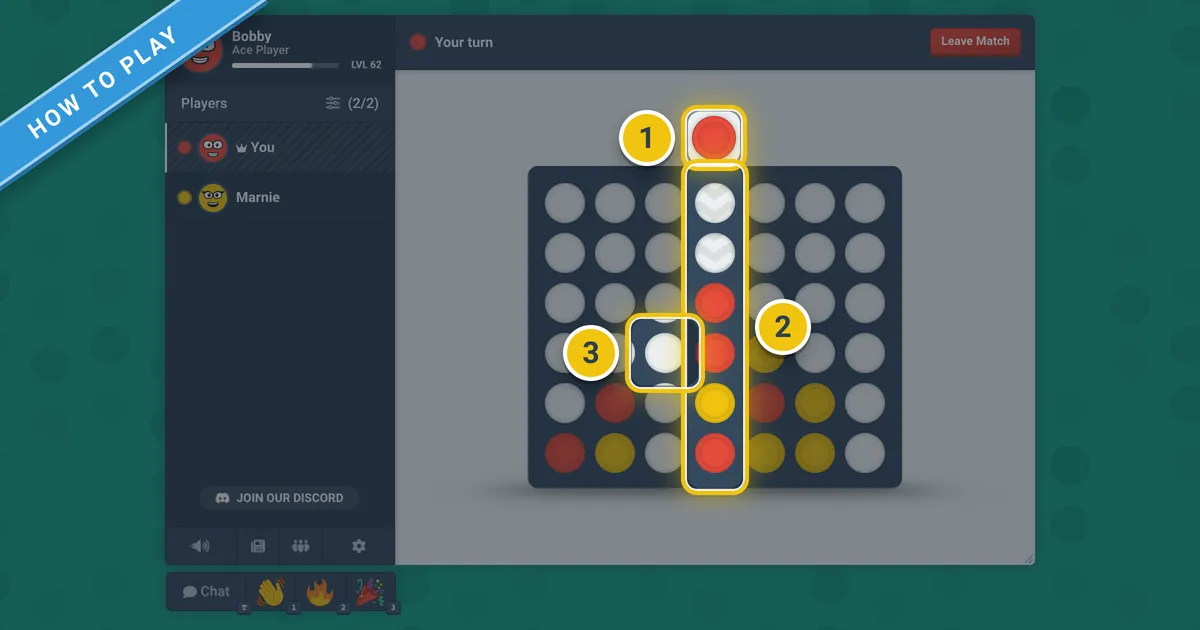
This guide covers the key strategies to win games of Connect 4, a two-player game where you take turns dropping colored discs into a standing grid. Discs fall to the lowest open space in the column they're dropped into. The first player to connect four of their own discs in a row, whether across, up and down, or on a slant, wins. The game takes a minute or so to learn.
You can try the ideas in this guide as you read. You can play Four in a Row free on Bloob.io with friends or against bots. No account, no download.


What you need
- A grid with 7 columns and 6 rows (42 spaces)
- 21 discs for each player, in two colors
- Two players
The goal of the game is to be the first to get four of your discs in a line.
How a turn works
- Pick a column. Any column that is not full.
- Drop one disc. It falls to the lowest empty space in that column.
- Check for four. If your disc completes a line of four, you win.
- Pass the turn. Your opponent drops a disc, and so on.
A line of four can be horizontal, vertical or diagonal. If all 42 spaces fill up and nobody has four, the game is a draw. These are the rules in Hasbro's Connect 4 box.
In this guide, columns are named a to g from left to right, and rows are 1 to 6 from the bottom. So d1 is the bottom space of the middle column.
Strategy tips
Take the middle column
The middle column (d) is the most valuable one. A disc there can be part of more lines of four than a disc anywhere else. There are 69 possible lines of four on the board. Here is how many of them pass through each space:
| Row | a | b | c | d | e | f | g |
|---|---|---|---|---|---|---|---|
| 6 | 3 | 4 | 5 | 7 | 5 | 4 | 3 |
| 5 | 4 | 6 | 8 | 10 | 8 | 6 | 4 |
| 4 | 5 | 8 | 11 | 13 | 11 | 8 | 5 |
| 3 | 5 | 8 | 11 | 13 | 11 | 8 | 5 |
| 2 | 4 | 6 | 8 | 10 | 8 | 6 | 4 |
| 1 | 3 | 4 | 5 | 7 | 5 | 4 | 3 |
A corner is in only 3 lines, and the middle of column d is in 13. If you go first, start in the middle. Keep playing near the middle early on, and leave the edge columns for later.
Make threats
A threat is an empty space that would make four in a row for you. So three of your discs with a gap between them, like d2, e2 and g2 with f2 empty, is a threat on f2.
A threat your opponent can block right away isn't worth much. The best threats are the ones that can't be played yet, because the space below them is still empty. Your opponent can't block those. And nobody wants to drop a disc right under a threat, because the other player then plays on top of it.
Look for double threats
Since your opponent can only block one threat at a time, try to make two threats at once. They block one, and you play the other. This is how most games are won.
The best double threat is two of your threats stacked on top of each other in the same column. When the lower space becomes playable, you win. If it's your turn, you play the lower space. If it's your opponent's turn, they're forced to block the lower space, and you play on top of it.
Know your rows: odd and even threats
As the game goes on, most of the columns fill up with discs, and the players run out of safe moves. Sooner or later, someone is forced to play right under the other player's threat. This is called zugzwang: you have to move, but every move you can make is bad for you.
Who gets forced? The board has 42 spaces, an even number, and the turns alternate. Work it through and it comes out like this: when everything else is full, the first player gets the spaces on the odd rows (1, 3, 5) and the second player gets the even rows (2, 4, 6). So:
- If you went first, try to make a threat on an odd row (3 or 5).
- If you went second, try to make a threat on an even row (2, 4 or 6).
As the second player, you can try the follow-up: drop your disc right on top of the last disc your opponent played, in the same column. Every time you do this, you take an even-row space. It gets more complex when both players have threats, but as a rule of thumb: first player odd, second player even.
Block, but block smart
Before every move, ask two questions:
- Can I win right now? Look for a space that gives you four.
- Can my opponent win on their next move? If so, block that space.
Then look one step further: check the space right above where your disc would land. If that space wins for your opponent, don't play there. And block three in a row with both ends open early, because two open ends can turn into a double threat.
Set the 7 trap
The 7 trap is a shape of five discs that looks like the number 7. Three discs sit side by side on one row (the top of the 7), and two more run down on a slant from the right end (the stroke of the 7).
| Row | a | b | c | d | e | f | g |
|---|---|---|---|---|---|---|---|
| 4 | ? | ||||||
| 3 | X | X | X | ? | |||
| 2 | X | ||||||
| 1 | X |
Here the row c3, d3, e3 threatens f3, and the slant c1, d2, e3 threatens f4. Both spaces are stacked in column f, which is the double threat from above. Your opponent can block f3, and then you win on f4. The 7 trap also works mirrored, facing left.
Worked example
Your opponent went first. They have discs on b2, c3 and d4, a slant that needs e5 to make four. Column e has three discs in it, so e4 is the next open space there.
- Can you win right now? Say no.
- Can they win on their next move? No. e5 isn't playable yet.
- Check above. If you drop in column e, your disc lands on e4. Your opponent then plays e5 and wins. So column e is off limits for you.
Now look at the row. e5 is on row 5, an odd row, and your opponent went first. That's the best kind of threat for them. As the other columns fill up, you'll usually be the one forced to play e4. To save the game, you need an even-row threat of your own.
Common variations
- Pop Out. Some Hasbro editions let a player pop one of their own discs out of the bottom row on their turn, instead of dropping a new one.
- 5-in-a-Row. This is a Hasbro variant on a board 9 columns wide, where the outer columns start filled with discs in alternating colors, and you need five in a row to win.
- Bigger boards. Some boards have more columns or rows, sometimes for more than two players.
Four in a Row on Bloob.io
A default match of Four in a Row on Bloob.io is the standard game: a 7 by 6 board, four in a row to win, and a draw when the board fills. Each turn has a 15-second timer. If time runs out, a disc is dropped for you in the column you're pointing at, or in the first open one. Who goes first is random, and in a rematch the start passes to the next player.
A match holds two to six players. You can add bots, and the host picks how strong they are: Easy, Normal (the default) or Hard. You can also add Local Players to share one device.
The host can change these settings in the lobby:
- Field Size. Default (7x6), Stretched (9x4), Large (9x6), Very Large (13x8) or Extreme (17x10).
- Winning Condition. Three, four, five or six in a row.
- Side Columns. The outer column on each side starts filled with discs in alternating colors.
- Field Flip and Turns to Flip. Every few turns, the board turns upside down and the discs fall again.
- Tetris Mode. A full bottom row disappears and everything drops down a line, so a draw can't happen.
- Turn Time (3 to 120 seconds), or switch the Time Limit off.
There are also four ready-made presets. Four-in-a-row is the standard game. Five-in-a-row is a Large board with Side Columns and five to win, like Hasbro's variant. Tetris is the standard board with Tetris Mode on. Flip Party is a Very Large board that flips every 13 turns.
Can the first player always win at Connect 4?
Yes, with perfect play. Connect 4 was solved in 1988 by James D. Allen, and independently about two weeks later by Victor Allis. On the standard 7 by 6 board, the first player can force a win by playing in the middle column first. If the first player starts in either column next to the middle, perfect play by both players ends in a draw. If they start in any of the four outer columns, the second player can win. Since no person plays perfectly, real games can still go either way.
What is the best first move in Connect 4?
The middle column. It's the only first move that wins with perfect play, and it gives your discs the most lines to use.
Is it better to go first or second in Connect 4?
First. The first player has the edge, and with perfect play can always win. The second player should aim for even-row threats and use the follow-up to take away the first player's odd-row chances.