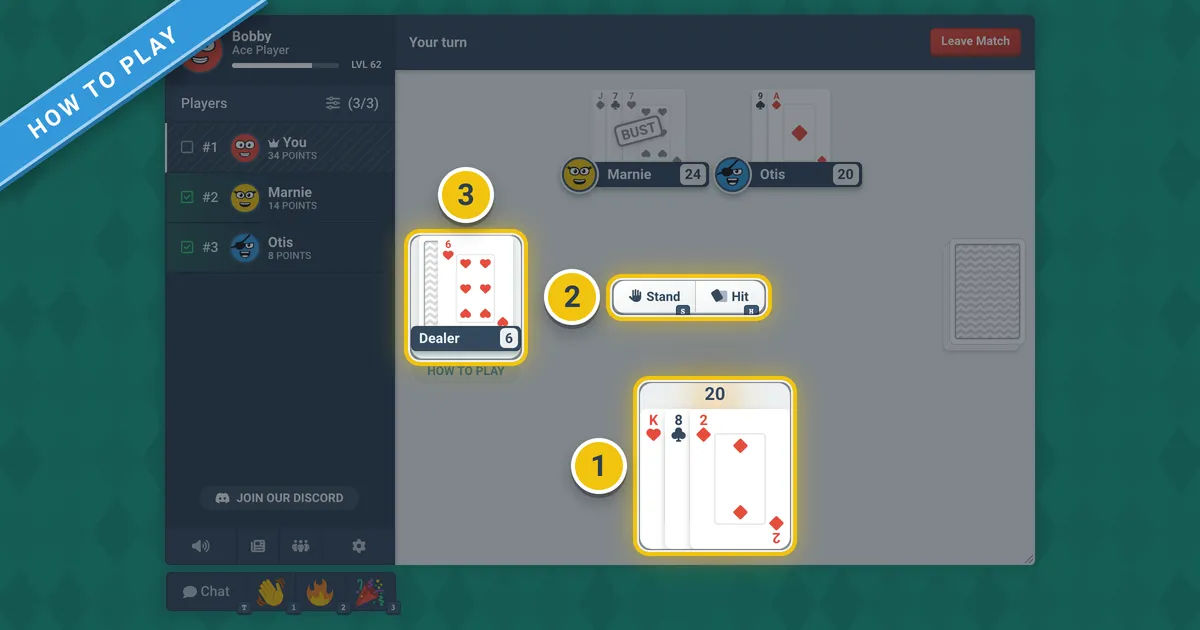
Blackjack is played against the dealer, not other players. Every player starts with two cards and players try to get as close to 21 as possible with additional cards. If a player goes over 21 they lose the hand, even if the dealer also goes over 21. If the player does not go over 21 the dealer must play, and whoever has the higher total wins.
The quickest way to learn is to play a few hands as you read through the guide. Bloob.io's Blackjack can be played for free with friends or bots. No registration is required and there are no downloads. All hands are played for points, not money.

Card values and the objective
- Cards 2 to 10 are worth their number.
- Jacks, queens and kings are worth 10.
- An ace is worth 11, or 1 if 11 would take your hand over 21.
There are two kinds of hands in Blackjack: soft and hard. A soft hand is a hand that has an Ace that is being counted as 11, such as Ace-6. A hard hand is any other hand. A soft hand can never bust on the next card, because the Ace will drop to a 1, making it a safe hand to hit.
An ace and any 10-value card as the first two cards of a hand is a Blackjack, also called a natural. This is the highest hand in the game.
The objective of Blackjack is to get a higher total than the dealer without going over 21. Suits of the cards have no effect on the value of a hand.
How a round is played
- Bet. In a casino, everyone places their wager before the cards are dealt.
- Deal. You and every other player at the table receive two cards face up. The dealer receives one card face up and one face down (the hole card).
- Players act. Each player in turn goes through their hand, taking cards as desired, until they decide to stand or they bust.
- Dealer plays. The dealer turns over the hole card and then follows a fixed set of rules for drawing cards.
- Settle. Each hand that did not bust is compared to the dealer's hand to determine a winner.
Your moves will be played before the dealer's, so if you go over 21 and bust then you lose, even if the dealer also goes over 21 a moment later.
Your moves
- Hit: take one more card. You can keep hitting as long as you like, until you bust.
- Stand: stop taking cards and keep what you have.
- Double down: double your bet, take exactly one more card, and then stand. You can only do this on your first two cards.
- Split: if your first two cards have the same value, split them into two hands. Each hand gets its own bet and a new second card.
- Insurance: a side bet, offered when the dealer's face-up card is an ace, that the dealer has blackjack.
- Surrender: at some tables, you can give up the hand straight away and lose only half your bet.
What the dealer must do
The dealer hits on 16 or less and stands on 17 or more. The one dealer rule that differs between Blackjack tables is whether the dealer stands on a soft 17 or hits it. A table where the dealer stands on a soft 17 is slightly better for the player than a table where the dealer hits it.
Who wins and what it pays
- You bust: you lose, even if the dealer busts afterwards.
- The dealer busts and you didn't: you win.
- Nobody busts: the higher total wins.
- Equal totals: it's a push, and you get your bet back.
Winning hands pay out 1 to 1 (meaning you win the amount you bet). Blackjack pays out 3 to 2 on most Blackjack tables (meaning a $10 bet on a Blackjack hand would pay out $15). Some Blackjack tables pay out 6 to 5 on Blackjack hands. Insurance pays out 2 to 1 on most Blackjack tables.
Basic strategy chart
Your best moves for any hand, given the dealer's face-up card, are listed below. "vs 3-6" means "when the dealer's face-up card is a 3, 4, 5 or 6". A dealer's face card counts as 10.
For example, if you have a 10 and a 2 (hard 12) and the dealer shows a 5, then you would look up 12 in the first chart and see that you stand against 4 to 6. So you would stand and hope the dealer busts.
The chart below assumes you are playing for money, but can be used for free play as well. This chart is for Blackjack tables with 4 to 8 decks, the dealer standing on soft 17, players being able to double on any two cards and after a split, and no surrender.
Hard totals (no ace counted as 11)
| Your hand | Best move |
|---|---|
| 8 or less | Hit |
| 9 | Double vs 3-6, otherwise hit |
| 10 | Double vs 2-9, otherwise hit |
| 11 | Double vs 2-10, hit vs ace |
| 12 | Stand vs 4-6, otherwise hit |
| 13 to 16 | Stand vs 2-6, otherwise hit |
| 17 or more | Stand |
Soft totals (ace counted as 11)
| Your hand | Best move |
|---|---|
| A+2, A+3 | Double vs 5-6, otherwise hit |
| A+4, A+5 | Double vs 4-6, otherwise hit |
| A+6 | Double vs 3-6, otherwise hit |
| A+7 | Double vs 3-6, stand vs 2, 7, 8, hit vs 9, 10, ace |
| A+8, A+9 | Stand |
Pairs
| Your pair | Best move |
|---|---|
| A+A, 8+8 | Always split |
| 10+10 | Never split, stand |
| 9+9 | Split vs 2-6 and 8-9, stand vs 7, 10, ace |
| 7+7 | Split vs 2-7, otherwise hit |
| 6+6 | Split vs 2-6, otherwise hit |
| 5+5 | Never split, play as a hard 10 |
| 4+4 | Split vs 5-6, otherwise hit |
| 2+2, 3+3 | Split vs 2-7, otherwise hit |
Sometimes the chart says to double, but you already have 3 cards. In this case you hit instead of double down. The only exception is a soft 18, in which case you stand.
Strategy tips
- Watch the dealer's card. If the dealer has a 2 to 6, then you can expect them to bust quite often. This means that you can afford to stand on weak hands like 13 and let the dealer take the risk of busting. If the dealer has a 7 or higher, keep hitting until you reach 17.
- Skip insurance. It sounds like a protection bet, but on average it costs more than it wins.
Common variations
- Decks: can range from 1 to 8 decks. Generally, the fewer decks, the better for the player.
- Doubling down: some tables only allow doubling down on 9, 10, or 11, or not after a split.
- Splitting: how many times a player can split can vary from table to table. Also, split aces are usually dealt only 1 card each.
- Five Card Charlie: a hand of 5 cards that hasn't busted wins automatically.
How Blackjack on Bloob.io plays
Blackjack on Bloob.io can be played with 1 to 4 players against the dealer. Bloob.io Blackjack is played for points, not money, so there is no risk of losing money.
- A match consists of 10 rounds of Blackjack, and the player with the most points at the end wins. Points are awarded for winning hands. Winning a hand is worth 5 points. Winning a hand with a total of 21 is worth an additional 5 points.
- The default settings use 2 decks of cards for Blackjack, one of the dealer's cards is hidden from view, and the dealer always stands on 17 (even on a soft 17).
- You can double down on any first two cards, even after you have split. You can split once and any two cards of the same value count as a pair, so a 10 and a King count as a pair.
- A natural blackjack of two cards is not an automatic win, but is a normal 21. There is no option to surrender.
Most of the above can be changed in the lobby settings: the number of decks (1-8), whether you can double down and split, whether a split must be of identical cards (e.g. 10 and 10), whether the hidden card of the dealer is shown, whether a natural blackjack of two cards wins instantly (Natural Blackjack), and whether Five Card Charlie is enabled (Five Card Charlie). The preset Wager Only gives everyone 25 points to bet with. A winning hand pays out 1 to 1, and the option to take insurance is offered when the dealer shows an Ace.
The strategy chart assumes you are betting, so it is most useful in a match with wagers.
Does a blackjack beat 21?
Yes, in a casino a blackjack consisting of two cards beats a 21 made up of three or more cards. On Bloob.io this is only true when Natural Blackjack is switched on.
Where can I practice blackjack for free?
You can practice Blackjack for free on Bloob.io. No account is required and you can play on your own, with friends or with bots.