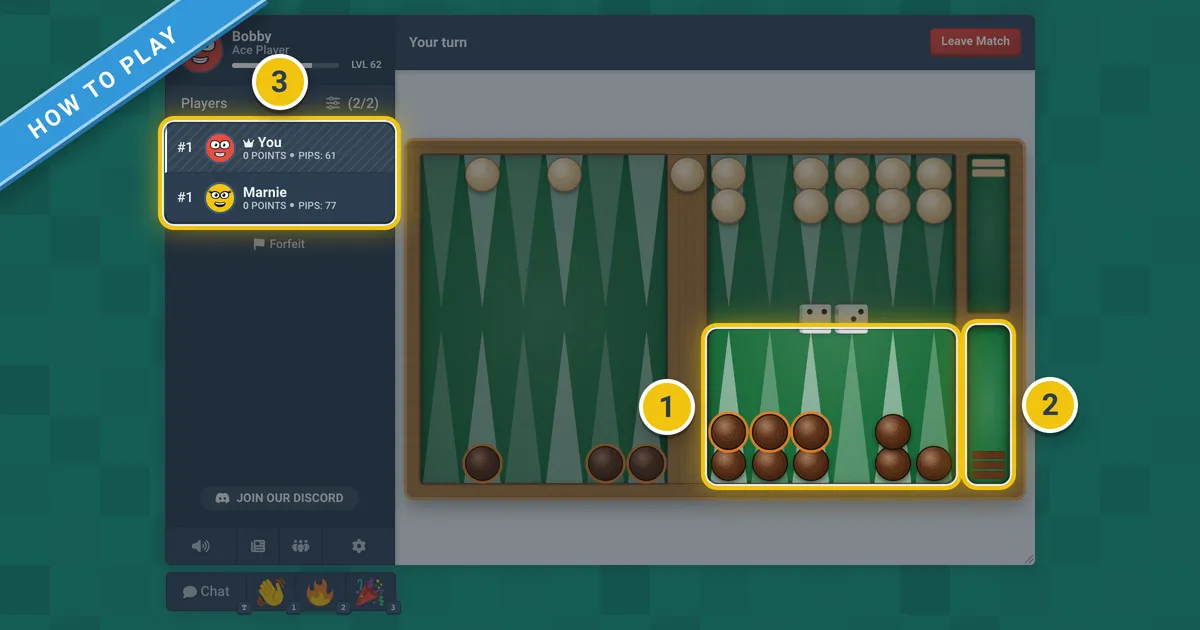
Backgammon is a racing game for two players. Each player has fifteen checkers and moves them around the board in opposite directions with the help of two dice. Your goal is to move all your checkers to your home board and then take them off the board. The first player to bear off all fifteen checkers wins the game. During the game you can hit your opponent's checkers and send them back to the start, and that is usually where a game of backgammon is decided.
The rules are easy to learn. You can play Backgammon free on Bloob.io against friends or bots while you are learning. No account or download is required.
What you need
- A backgammon board with 24 points, in four quarters of six
- Fifteen checkers for each player, in two colours
- Two dice for each player, or one pair of dice to share
The board and the setup
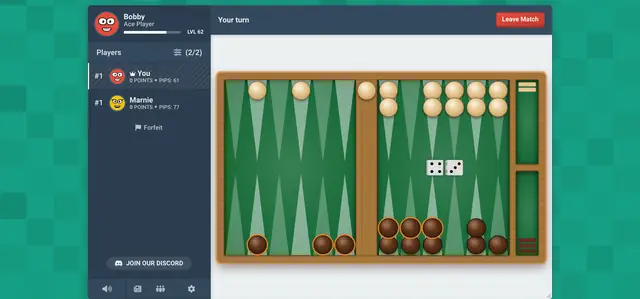
The backgammon board consists of 24 points (narrow triangles) in four quarters of six. Your home board is the quarter where your checkers finish the game. The bar in the middle divides the board into two halves.
Each player numbers the points from their own side. Your 1-point is the deepest point in your home board. Your 24-point is the furthest point from your 1-point, located in your opponent's home board. Your checkers move from your 24-point down to your 1-point. Your opponent's checkers move in the opposite direction.
This is how both players set up the board. Each player counts from their own side:
| Point | Checkers |
|---|---|
| 24-point | 2 |
| 13-point (the midpoint) | 5 |
| 8-point | 3 |
| 6-point | 5 |
At the beginning of the game each player needs 167 pips to bear off all their checkers. This number is called your pip count. It is the total distance your checkers have to travel. The player with the lower pip count is ahead in the race.
The opening roll
Each player throws one die. The player with the higher die starts the game, and uses both numbers on the dice as their first move. If both dice show the same number, both players throw again. After that, both players take turns throwing the dice.
How checkers move
- Throw both dice. Each die is one move.
- Move one checker per die. A 5 and a 2 moves one checker five points and another checker two points. Or you can move one checker seven points if it can stop on the point in between.
- Only land on open points. A point is open if it is empty, contains your own checkers or only one checker of your opponent. A point with two or more checkers of your opponent is blocked.
- Play doubles four times. A 4 and a 4 allows you to move four times four points. You can use one checker or several checkers.
You must use both dice if you can. If you can only use one of the two dice, you must use the higher one if possible. If you can't use either die, your turn is over.
Hitting and the bar
A single checker on a point is called a blot. If your opponent lands on it, it is hit and goes to the bar. The bar is the strip in the middle of the board.
A checker on the bar must enter again in your opponent's home board before you can move any other checkers. A die of 1 enters the checker on your 24-point. A die of 6 enters the checker on your 19-point. If both numbers you throw land on blocked points, you can't enter and you lose your whole turn.
The more points your opponent has blocked in their home board, the harder it is to enter:
| Points blocked | Chance to enter |
|---|---|
| 1 | 97% |
| 2 | 89% |
| 3 | 75% |
| 4 | 56% |
| 5 | 31% |
| 6 | 0% |
Bearing off
Once all fifteen checkers are in your home board, you can start bearing off. This means you take them off the board.
- A die takes off a checker from the point with that number. For example, a 4 takes off a checker from your 4-point.
- You can also use a die to move a checker inside your home board instead of bearing it off.
- If there is no checker on the point the die shows, you must move a checker from a higher point.
- If there is no checker on a higher point, you take off a checker from your highest occupied point.
If one of your checkers is hit while you are bearing off, it must go all the way back to your home board before you can bear off again.
Winning: gammons and backgammons
The first player to bear off all fifteen checkers wins the game. How much the win is worth depends on how far your opponent got:
| Result | When | Points |
|---|---|---|
| Single win | Your opponent has borne off at least one checker | 1 |
| Gammon | Your opponent has not borne off any checker | 2 |
| Backgammon | A gammon, and your opponent still has a checker on the bar or in your home board | 3 |
A match is a series of games played to a set number of points, such as five or seven. Gammons and backgammons make a match much less predictable. One big win can turn the whole match around.
The doubling cube
Most club and tournament games use a doubling cube. This is a die marked with the numbers 2, 4, 8, 16, 32 and 64. At the beginning of your turn, before you throw, you can offer to double the stakes. Your opponent can either accept the double and take the cube, or decline the double and lose the game at the current value. Only the player who holds the cube can offer the next double. The value on the cube multiplies the points of a win. For example, a gammon with the cube on 4 is worth 8 points.
In a match, the Crawford rule is normally used. In the game right after a player comes within one point of winning the match, nobody may double.
Strategy tips
- Make points in your home board. Two checkers on a point block it. Every point you block in your home board makes it harder for a hit checker to enter again.
- Build a prime. Six blocked points in a row is a prime. A checker behind a prime can't get past it.
- Learn the best opening moves. With 3-1, move 8/5 and 6/5 to make your 5-point. With 4-2, move 8/4 and 6/4. With 6-1, move 13/7 and 8/7 to make your bar point.
- Count the shots. A blot that is close to an enemy checker is easier to hit. Without anything in the way, a blot six points away is hit by 17 of the 36 throws (47%). A blot eight points away is hit by only 6 throws (17%).
- Know when it is a race. Once all of your checkers have passed your opponent's checkers, hitting is over. Compare your pip counts and move as efficiently as possible.
Common variations
- Jacoby rule. In games played for stakes rather than in matches, gammons and backgammons only count once the cube has been doubled.
- Automatic doubles. If the opening throw is a tie, the cube is doubled.
- Beavers. A player who is offered a double can accept it and immediately double it again while keeping the cube.
- Nackgammon. This is a different setup. You have two checkers on your 24-point, two on your 23-point, four on the midpoint, three on your 8-point and four on your 6-point. This makes for longer games.
Backgammon on Bloob.io
Backgammon on Bloob.io plays with the standard rules above. There is no doubling cube. There are two ready-made presets. Single Game is one game, and the first player to bear off every checker wins. Match to 5 is a match where the first player to five points wins, and gammons and backgammons count.
In the lobby you can set the match length to any odd number from 1 to 15. You can turn off gammons so that every win is worth one point. You can also set the time for each turn or play without a timer. Play against a bot at easy, normal or hard, or against a friend on their own device or on the same screen.
When you throw the dice, every checker you can move is highlighted. Click a checker to see every point it can reach. Click the point to move it. If you change your mind, you can undo your move before the turn ends. Your pip count is always shown, so you don't have to count it yourself.
Who goes first in backgammon?
Each player throws one die. The player with the higher die starts the game, and uses the numbers on both dice as their first move. If the dice are equal, both players throw again.
Do you have to use both dice in backgammon?
Yes, if you can. If only one of the two dice can be played, you must use the higher one if possible. If neither can be played, your turn is over.
What happens when you roll a double in backgammon?
You play the number four times instead of twice. For example, with a 3 and a 3 you move four times three points. You can use one checker or several checkers.
Can you play backgammon online with friends?
Yes. You can play Backgammon on Bloob.io for free with friends or against bots. Start a game and send the link. You don't need an account or a download. It runs in your browser.