9 Ball is a fast-paced pool game for two players. You only use the balls numbered 1 to 9, and on each shot you must hit the lowest-numbered ball on the table first. However, you don't have to pocket them in order. You win the game if you pocket the 9 ball on a legal shot, even if there are other balls left on the table.
The quickest way to get started is to play along as you read. You can play 9 Ball Pool free on Bloob.io against a friend or a bot. No account, no download.

What you need
- A pool table with six pockets
- A cue ball and nine object balls, numbered 1 to 9
- Two players
The rules below are the World Pool-Billiard Association (WPA) rules, which most tournaments use. Bars and leagues often use house rules (see the variations below).
Racking the balls
The balls are racked in a diamond pattern:
- The 1 ball is at the front of the diamond, on the foot spot.
- The 9 ball is in the middle.
- The other seven balls can go anywhere in the diamond, in any order.
The break
The breaker puts the cue ball anywhere behind the head string (the line across the table at the breaker's end) and shoots at the rack.
- Hit the 1 ball first. It's a foul to hit any other ball first.
- Make a real break. You must either pocket a ball or drive at least four object balls to a rail. If you don't, it's a foul.
- If you pocket a ball, keep shooting. If you don't, your turn ends.
If the 9 ball is pocketed on a legal break, the breaker wins right away. If the breaker scratches (pockets the cue ball) on the break, it's a foul, and a pocketed 9 ball is spotted: put back on the table on the foot spot.
How a turn works
- Find the lowest-numbered ball on the table. This is your target.
- Hit it first with the cue ball. The first ball the cue ball touches must be the target.
- Pocket a ball or send a ball to a rail. After the cue ball hits the target, either a ball must go in, or some ball (the cue ball counts) must touch a rail.
- Keep going. If you pocketed any ball, you get another shot. If not, your turn ends and your opponent shoots from where the cue ball stopped.
Any ball pocketed on a legal shot counts, even if it's not the target ball.
Combinations and caroms
Since any ball pocketed on a legal shot counts, you can win early:
- Combination. You hit the lowest ball into the 9 ball, and the 9 goes in.
- Carom. The lowest ball, or the cue ball after hitting it, bounces off the 9 ball and knocks it in.
Both are legal, as long as the cue ball hit the lowest ball first. For example, the 2 ball is the lowest ball on the table, and the 9 ball is near a corner pocket. You hit the 2 ball into the 9 ball, and the 9 drops. You win, even though there are six balls still on the table.
Push out
The shot right after the break has a special option called a push out. The player whose shot it is can say "push out" before shooting. During a push out:
- The cue ball doesn't have to hit the lowest ball, or any ball.
- No ball has to touch a rail.
- It's still a foul if you pocket the cue ball.
- Any ball that goes in doesn't count. If the 9 ball goes in, it's spotted.
The other player then chooses to shoot from where the cue ball stopped, or to pass the shot back to the player who pushed out. So push the cue ball to a spot that looks equally hard for both of you.
Fouls and ball in hand
Common fouls include:
| Foul | What happened |
|---|---|
| Scratch | The cue ball went into a pocket or off the table |
| Wrong ball first | The cue ball hit some other ball before the lowest ball |
| No ball hit | The cue ball didn't touch any ball |
| No rail | No ball was pocketed, and no ball touched a rail after contact |
| Bad break | No ball was pocketed, and fewer than four balls reached a rail |
If you foul, your turn ends and your opponent gets ball in hand. They can pick up the cue ball and place it anywhere on the table before shooting.
Balls pocketed on a foul stay down, except for the 9 ball. If the 9 ball goes in on a foul, it's spotted, and no one wins yet.
Three fouls in a row
Under WPA rules, if you foul on three shots in a row without a legal shot in between, you lose the game. The referee or your opponent must warn you after the second foul. Many casual games don't use this rule.
How you win
You win if you pocket the 9 ball on a legal shot: on the break, with a combination or carom, or after all the other balls are gone. You also win if your opponent fouls three times in a row, if you're playing with that rule.
Because a game of 9 Ball is short, matches are often a race to a set number of games, like first to 7 or 9.
Strategy tips
- Think ahead to the next ball. Good players plan the order: pocket the 1 ball and stop the cue ball where the 2 ball is easy. This is called pattern play, or position play.
- Play safe if the shot is hard. If you can't pocket the target, it's often better to play a safety: hit the lowest ball legally, but leave the cue ball where your opponent has no clean shot at the next ball.
- Don't foul if you're stuck. Ball in hand often lets your opponent run out the table.
- Use spin to get position. Topspin makes the cue ball roll forward after contact, and backspin draws it back.
Common variations
- 9 on the break. In some events and leagues, the 9 ball is spotted on the break instead of giving the win.
- No push out. Many bar games don't use the push out, and the player after the break just shoots.
- Call the 9. Some house rules only count a combination on the 9 ball if you named it before the shot.
- Break box. In some tournaments, the breaker has to place the cue ball in a small box instead of anywhere behind the head string.
9 Ball Pool on Bloob.io
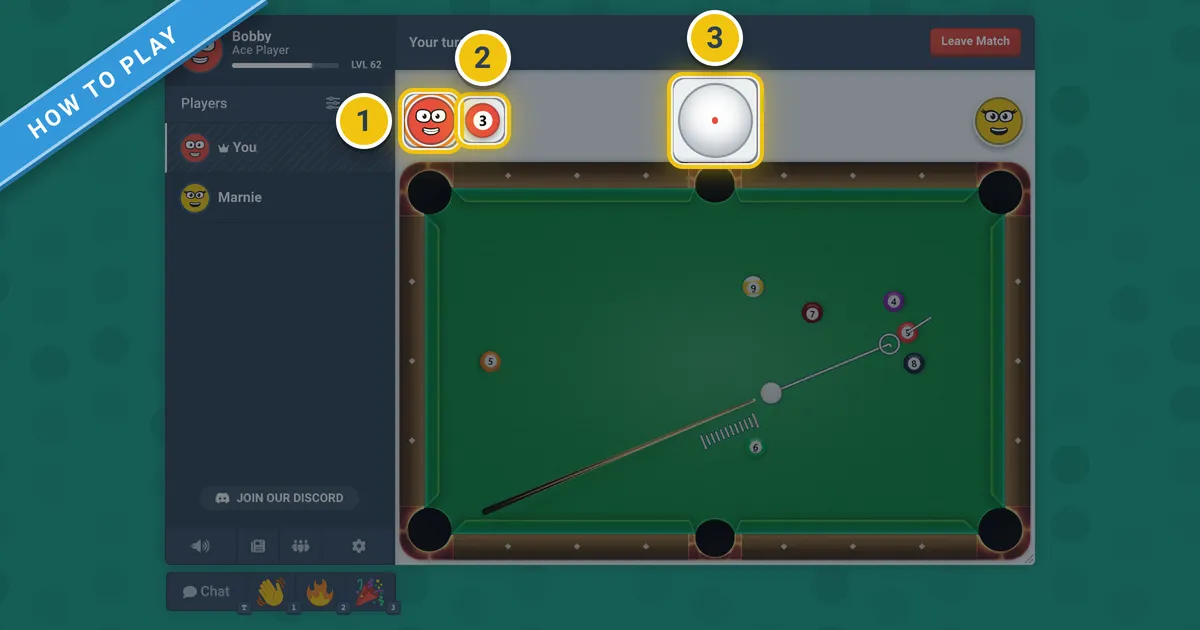
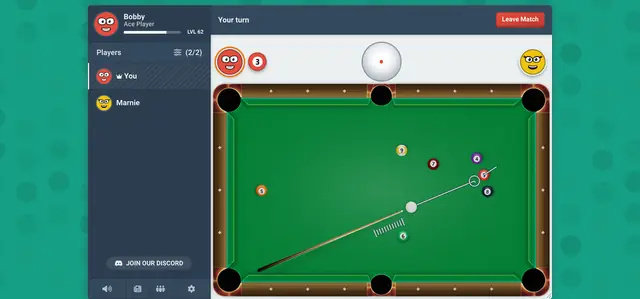
The rules of Bloob.io's 9 Ball Pool closely follow the official ones. By default, a match of 9 Ball Pool on Bloob.io is for two players. For the break, you can place the cue ball anywhere in the quarter of the table at your end. The break must hit the 1 ball first and either pocket a ball or send four balls to a rail. If you make a bad break, the turn just passes to your opponent, with no ball in hand. After any other foul, your opponent gets ball in hand anywhere on the table. Each shot has 35 seconds, and if you run out of time, your opponent gets ball in hand. The ball you must hit first is shown next to the player whose turn it is.
The default ruleset has no push out and no limit on fouls in a row. The BCA Ruleset preset closely resembles the Billiard Congress of America rules: it adds the push out and makes you lose after three fouls in a row. When a push out is allowed, the player after the break gets a Push Out button. Their opponent can then shoot, or press Skip turn to pass the shot back.
The host can change any of the rules in the lobby settings:
- Rail on Break. How many balls must reach a rail on the break (one to four), or Optional.
- Must Contact Rail and Must Hit Ball. Turn those fouls on or off.
- Consecutive Fouls. Off, or a loss after two, three or four fouls in a row.
- Push Out. On or off.
- Pocketing Cue Ball. What a scratch costs, from ball in hand to an instant loss.
- Turn Time, Aiming Line (on by default) and Speed (how fast the shots play out).
You can also play against a bot. The host picks the bot's level in the lobby: Easy, Normal or Hard.
Do you have to hit the balls in order in 9 Ball?
You have to hit the balls in order, but you don't have to pocket them in order. The cue ball must touch the lowest-numbered ball first. After that, any ball that goes in counts, and you keep shooting.
Can you win 9 Ball on the break?
Yes. Under WPA rules, if you pocket the 9 ball on a legal break, you win right away. If you also scratch on the break, it's a foul and the 9 ball is spotted. Some leagues spot the 9 ball on the break instead of giving the win.